 Wonkyeong Son, Jae Myeong Lee, Hyunji Seo, Gyu Hyeon Song, Seon Jeong Kim, Sooncheol Kwon, Sung Beom Cho, Sungwoo Chun, Shi Hyeong Kim & Changsoon Choi
Department of Electronic Engineering and Biomedical Engineering, Hanyang University, Seoul, Republic of Korea.
Department of Energy and Materials Engineering, Dongguk University-Seoul, Seoul, Republic of Korea.
Department of Materials Science and Engineering, Ajou University, Suwon, Republic of Korea.
Department of Electronics and Information Engineering, Korea University, Sejong, Republic of Korea.
Textile Innovation R&D Department, Korea Institute of Industrial Technology, Ansan, Gyeonggi-do, Republic of Korea. Department of Advanced Material Engineering, Chung-Ang University, Anseong, Gyeonggi-do,
Republic of Korea.
*Corresponding author.E-mail: shk@kitech.re.kr; pccs2004@hanyang.ac.kr.
원문 링크 : https://doi.org/10.1038/s41528-025-00493-6
Abstract
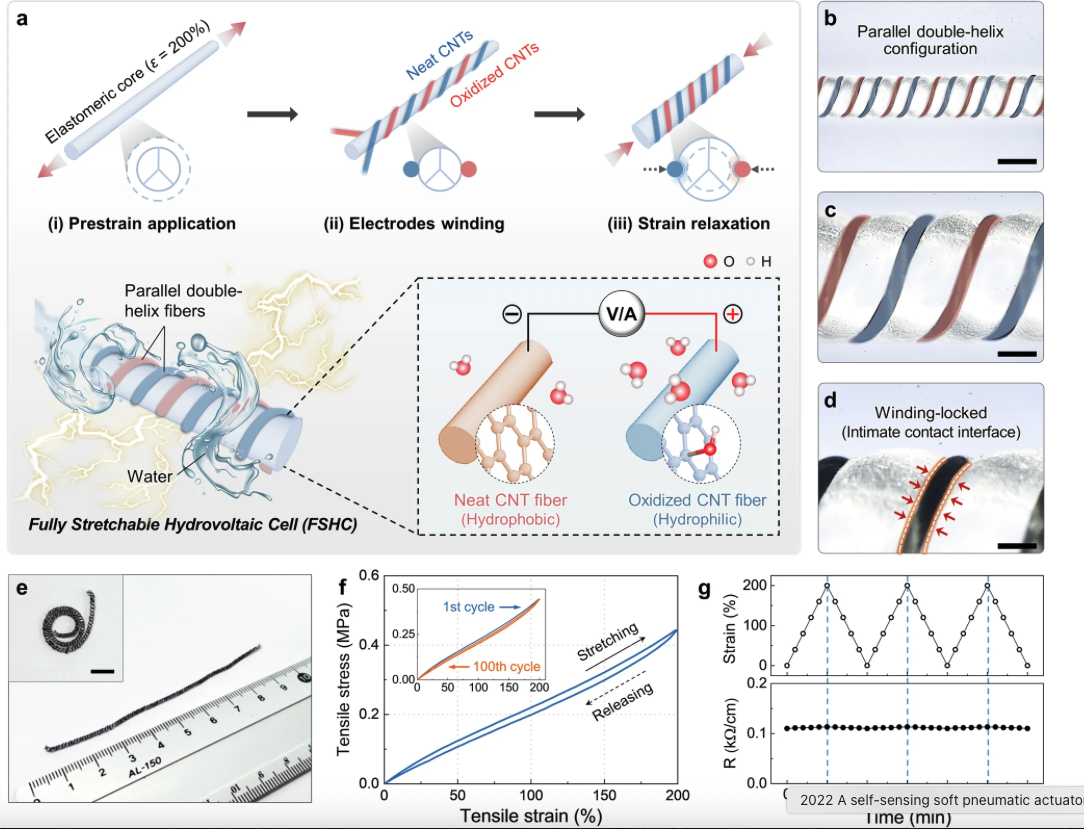
Hydrovoltaic power generators that convert water–nanomaterial interactions into electricity represent a promising route for sustainable energy harvesting. However, most previous studies have relied on non-stretchable planar designs, requiring continuous water flow or ionic solutions. Here, we present a fully stretchable hydrovoltaic cell (FSHC) with a parallel double-helix configuration of neat and oxidized carbon nanotube (CNT) fibers wound around an elastomeric core. This winding-locked double-helix architecture ensures mechanical robustness and stable electrical properties under strain. When immersed in quiescent deionized water, the FSHC generates ~0.31 V and ~22.4 µA/cm2, maintaining reliable performance up to 200% strain. To demonstrate its potential in wearable applications, the FSHC is integrated into a fabric glove. Moreover, multiple FSHCs connected in series or parallel provide sufficient power to drive a twisted CNT fiber actuator. This study introduces a deformable hydrovoltaic platform for fiber-based energy harvesters, broadening their applicability to wearable electronics and self-powered actuation.